

Whether you’re a homeowner planning a renovation or a builder running a commercial project, knowing the scaffolding rules can save you from costly mistakes and, more importantly, from serious harm. Here are the key laws, standards and responsibilities in plain English.
The rules that apply
Scaffolding in New Zealand is covered by a mix of laws, regulations and guidance:
Health and Safety at Work Act 2015 (HSWA): the main law covering safety at work, including work at height.
Health and Safety at Work (General Risk and Workplace Management) Regulations 2016: specific rules for managing risks, including falls.
Health and Safety in Employment Regulations 1995: still the source of the rule that scaffolding of 5 metres or more needs a certified scaffolder, and must be notified to WorkSafe.
AS/NZS 4576 Guidelines for Scaffolding: the joint Australian and New Zealand standard for design, erection, use and dismantling.
WorkSafe and SARNZ guidance: including WorkSafe’s Working at height in New Zealand guidelines and SARNZ’s Best Practice Guidelines for Scaffolding in New Zealand.
There’s no “safe height”
Under HSWA, the duty to manage fall risk applies at any height. WorkSafe expects fall risks to be eliminated where possible and otherwise minimised with the most effective controls available. For most exterior work on a two-storey house, that means scaffolding.
When a certified scaffolder is required
If any part of a scaffold is 5 metres or more above the ground, it must be erected, altered and dismantled by someone with a current scaffolding Certificate of Competence (CoC) for that type of scaffold, or under their direct supervision. The work must also be notified to WorkSafe at least 24 hours before it starts.
Below 5 metres, no CoC is legally required, but the work must still be carried out by a competent person following the standards and guidelines.
CoCs are currently issued by SARNZ on WorkSafe’s behalf. WorkSafe is taking this over, with the handover planned around the end of 2026. The requirements themselves aren’t changing. Read more in our post on scaffolding certifications in New Zealand.
Who’s responsible for what
Under HSWA, safety on site is shared between everyone involved:
The scaffolding company must erect a scaffold that complies with the standards and is safe to use.
The main contractor, or the homeowner if they’re in control of the site, must make sure the scaffold is used correctly and maintained during the hire.
Workers and tradespeople must take reasonable care for their own safety and must not misuse or modify the scaffold.
Handover and inspections
A scaffold should be formally handed over once it’s built, with a walk-through to confirm it’s safe and fit for purpose, and a handover record kept. After that, it should be inspected:
before first use
at least every 7 days while it’s standing
after any alteration
after anything that could affect it, such as a storm, impact or ground movement
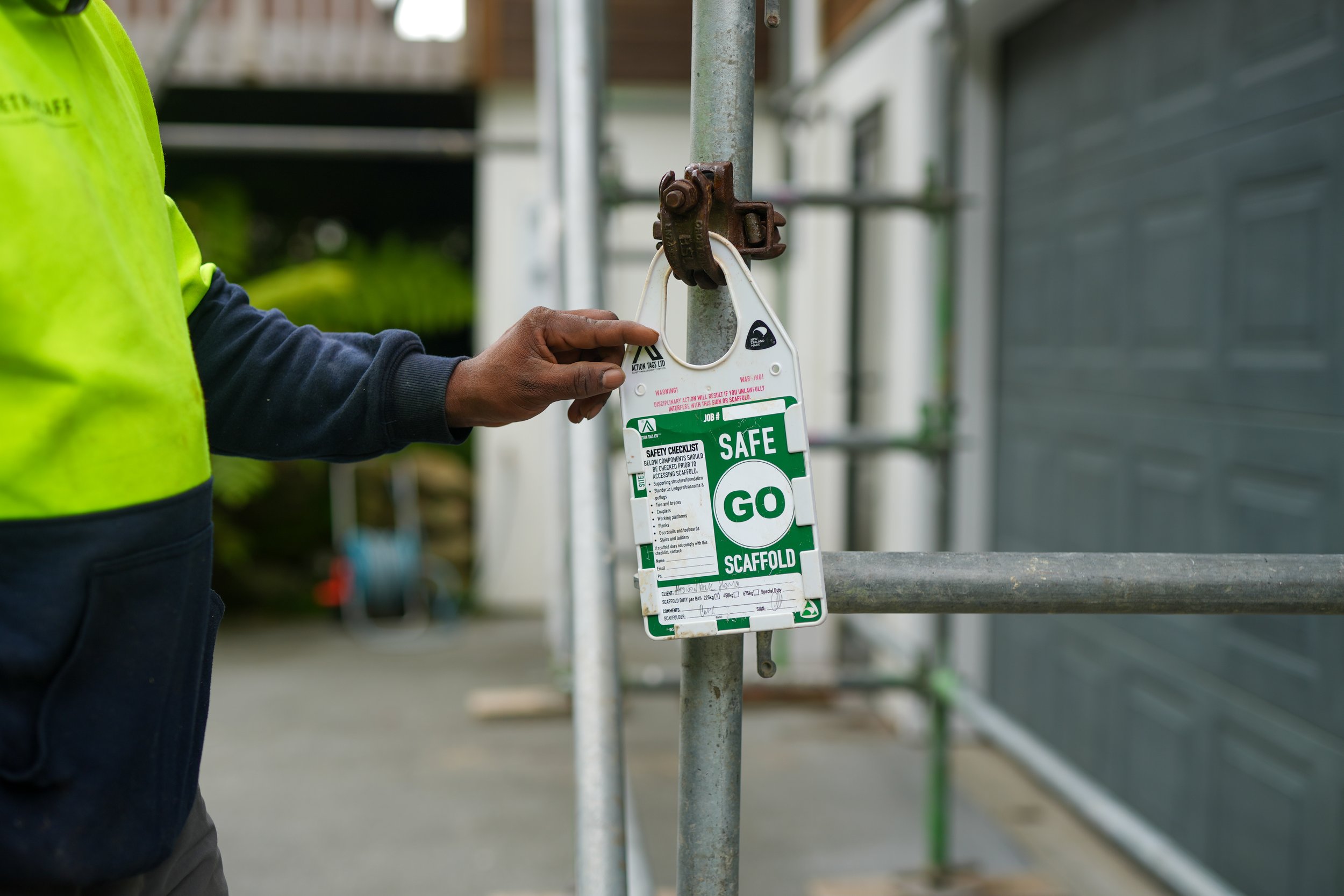
The tag at the access point shows when it was last inspected and whether it’s safe to use.
Never modify it yourself
Only a qualified scaffolder should alter a scaffold. If a board, guardrail or tie needs moving, call your scaffolding company. Unauthorised changes are one of the most common causes of scaffold incidents.
Don’t overload it
Every scaffold is rated for a certain load. Most residential scaffolds are light to medium duty, which suits painting and general maintenance. Stacking heavy materials on the platforms can exceed that. Ask your scaffolder what your scaffold is rated for.
What’s changing
Two updates are worth knowing about:
CoCs move to WorkSafe from around the end of 2026 (see above).
HSWA amendments take effect on 1 April 2027. They focus on “critical risks”, and working at height is one of them. Read more in our post on the Health and Safety at Work Amendment Bill.
Not sure if your scaffold is compliant?
Ask an experienced scaffolding professional. We’re always happy to talk through your situation. Call Metroscaff on 021 774 653 or email admin@metroscaff.co.nz.